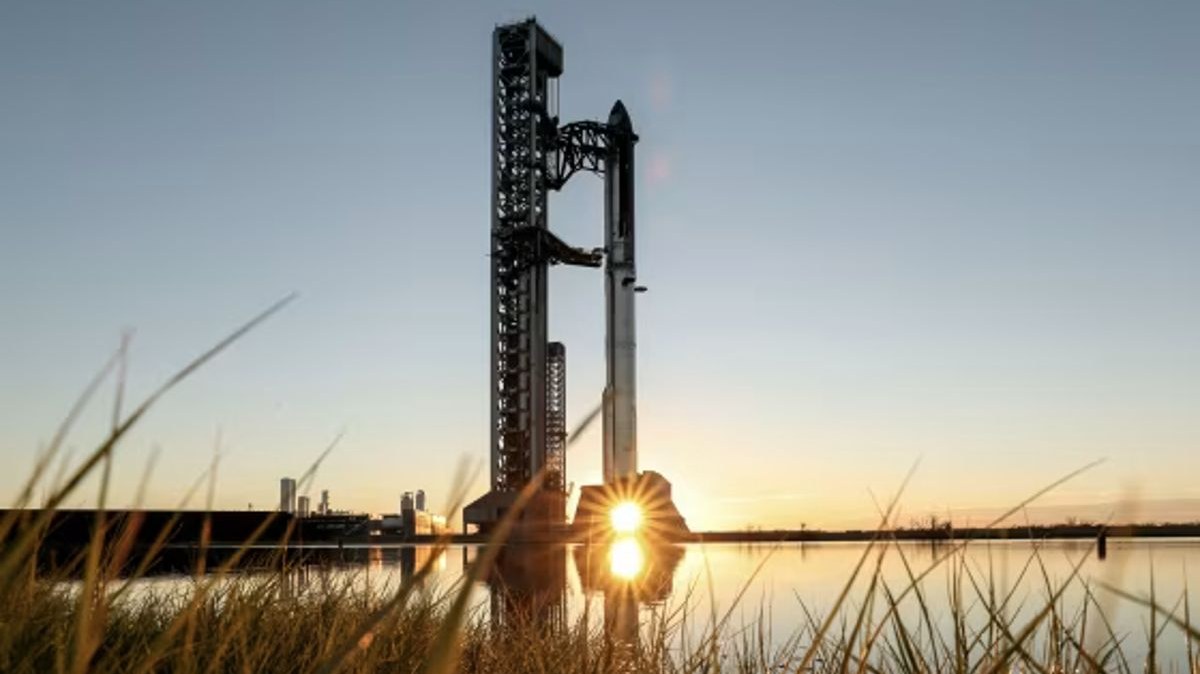
SpaceX launched its 15th Starship test flight from Starbase, Texas, on Friday, November 13, 2026, testing the company's ambitions for fully reusable orbital rockets. The mission successfully reached several major flight milestones and deployed 26 Starlink V3 satellites, but the Super Heavy booster recovery maneuver was abandoned, sending the rocket into the Gulf of Mexico.
According to CNN and Reuters, the uncrewed vehicle lifted off during a launch window that opened at 5:45 p.m. Eastern Time. SpaceX had planned to recover both rocket stages using mechanical arms attached to its launch tower, an unprecedented objective for a single orbital mission.
The Super Heavy booster, designated Booster 22, was equipped with 33 Raptor engines. According to SpaceX spokesperson Dan Huot, 32 engines were operating during the flight before stage separation.
After approximately 6.5 minutes, the booster was supposed to return to the launch tower for a controlled catch. However, SpaceX canceled the recovery attempt, and the vehicle instead splashed down in the Gulf of Mexico. The company did not immediately explain the decision.
SpaceX had previously completed three successful Super Heavy tower recoveries, with the most recent occurring in March 2025. Flight 15 was the first attempt involving the company's V3 booster generation.
Before launch, SpaceX spokesperson Dan Huot reported that preparations were proceeding without significant operational obstacles.
"T-5 minutes and we are tracking no issues," said Dan Huot, SpaceX spokesperson.
He also confirmed that the countdown had not encountered any interruptions.
"We have no holds on the board right now."
Earlier, Huot had described the launch conditions as favorable.
"We are not currently tracking any technical issues, any range issues and definitely no weather issues for today," said Dan Huot, SpaceX spokesperson.
The Federal Aviation Administration approved the launch shortly before the scheduled attempt. The approval came amid a nationwide aviation groundstop caused by a communications problem affecting air traffic control centers, according to Transportation Secretary Sean Duffy.
SpaceX proceeded with loading approximately 12 million pounds of liquid oxygen and liquid methane into the two-stage vehicle. The company had initially targeted liftoff at 5:45 p.m. Eastern Time before adjusting the schedule to 5:47 p.m.
During the flight, the spacecraft separated from its booster through a maneuver called hot staging. The upper vehicle ignited its own engines to move away from the first stage after the booster completed its primary burn.
The separation followed the Max Q milestone, the point at which the rocket experienced maximum aerodynamic pressure during its ascent. SpaceX's launch team subsequently authorized the spacecraft to ignite its engines and continue toward orbit.
According to CNN, the Starship spacecraft reached a nominal orbital trajectory and achieved a maximum planned speed of approximately 17,600 miles per hour, nearly 23 times the speed of sound.
SpaceX engineer and spokesperson Jesse Anderson reported that the spacecraft remained in good condition following the booster recovery decision.
"Everything is looking good," said Jesse Anderson, SpaceX representative.
The spacecraft subsequently began deploying 26 Starlink V3 satellites, expanding SpaceX's next-generation internet constellation. The satellites are stored flat inside the vehicle's cargo compartment and released through a narrow opening designed for payload deployment.
Flight 15 marked the second Starship mission to transport operational Starlink satellites into orbit. The previous deployment took place during the September test flight.
SpaceX planned to keep the spacecraft in orbit for approximately 22.5 hours before attempting its return on Saturday, November 14. The company intended to demonstrate a controlled atmospheric reentry and vertical landing near its Texas launch facilities. A successful spacecraft recovery would represent a major milestone in orbital vehicle reuse.
The mission also carries broader implications for SpaceX's commercial operations. Reuters reported that Starship is central to the company's plans to expand Starlink services and eventually transport orbital computing infrastructure.
SpaceX has invested at least $15 billion in Starship development, while NASA has provided approximately $3.2 billion since selecting the vehicle in 2021 as a lunar lander for its Artemis program. NASA and SpaceX are targeting a crewed lunar landing using Starship by 2028, although several technical milestones remain outstanding.
One major requirement involves demonstrating the transfer of propellant between Starship tanker vehicles in orbit. The technology is essential for missions traveling beyond Earth orbit toward the Moon.
Separately, National Public Radio reported that SpaceX's growing focus on Starship could affect NASA's dependence on the company's existing Falcon 9 and Dragon systems.
Caleb Henry, research director at Quilty Space, explained that Dragon has become the primary American transportation option for astronauts traveling to the International Space Station.
"Because Dragon has become such a successful and reliable vehicle, it became the de facto way for astronauts to get to orbit," said Caleb Henry, director of research at Quilty Space.
NASA announced three additional contracted Dragon missions in September. Assuming consecutive flights at six-month intervals, the current agreement would support transportation services through 2028 without additional contracts.
NASA addressed the continuing partnership in a statement to NPR.
"NASA and SpaceX continue to work closely together across numerous missions and contractual agreements, including crew and cargo transportation to the International Space Station," the space agency said.
The agency also described its position as the commercial space sector develops.
"As the commercial space industry evolves, so will the technologies and services available to NASA."
SpaceX founder Elon Musk has indicated that the company could eventually discontinue Falcon operations once Starship becomes sufficiently reliable. He described the intended shift in a statement published on X earlier this year.
"Once Starship is flying reliably several times per week, it makes sense to shift super scarce SpaceX engineering and production resources to Starship to get launch rate to several times per day, which means winding down Falcon," Musk said.
SpaceX President Gwynne Shotwell also discussed the company's transition toward newer launch technology at the All In summit in Los Angeles in September.
"We definitely want to move from the older technology to the newer technology," said Gwynne Shotwell, SpaceX president.
She compared the existing Falcon 9 and Dragon combination with the demands of longer-distance space exploration.
"A Falcon 9 with a Dragon capsule on top is like a minivan. … The road trip to Mars is six months — so you don't want to be in the minivan," Shotwell said.
However, the transition could create challenges for NASA and other customers. Quilty Space estimates that the commercial launch market could face a shortage of approximately 150 launches through 2030 if existing providers reduce their operations.
Tim Farrar, president of TMF Associates, said SpaceX's expanding business priorities have changed the company's commercial calculations.
"Today there is not a strong commercial market for human spaceflight," said Caleb Henry, director of research at Quilty Space.
Farrar described the limited financial importance of individual NASA missions to SpaceX's expanding operations.
"Although it seems likely that the individual missions are profitable, they're small potatoes."
SpaceX's financial figures cited by NPR show approximately $2.1 billion in launch revenue through September 2026, compared with $12.8 billion from Starlink and $10.9 billion from its artificial intelligence business.
The U.S. Space Force said it had secured Falcon 9 launches through 2028 and expressed confidence that other providers could accommodate additional national security launch requirements.
"Boeing has been paid, I think, probably more than we have been paid to develop their human capsule. So we're just going to let them have some business," Shotwell said.
She also indicated that Boeing should take a greater role in crew transportation.
Boeing's Starliner spacecraft has experienced significant development difficulties, including problems during its first astronaut transportation attempt in 2024.
Meanwhile, SpaceX has said it could begin launching Starship from a new Florida launchpad by the end of 2026. Musk has also expressed ambitions to increase Starship launch frequency to weekly operations during the first half of 2027.
The immediate remaining milestone for Flight 15 is the planned return of its upper-stage spacecraft following its orbital journey on November 14, 2026.
What's Your Reaction?
- 0Like
- 0Dislike
- 0Funny
- 0Angry
- 0Sad
- 0Wow