Unfortunately, for global stock market operators, Friday’s CPI will arrive with a different burden.
A soft core print would normally hand bonds something to rally on and perhaps give equities a cleaner relief trade. But if crude is still sitting in the mid-$90s or pressing toward $100/bbl when the number crosses, the market may get the inflation print it wanted and discover it arrived with yesterday’s timestamp.
Traders will immediately look beyond the backward-looking data toward energy pass-through, inflation expectations and the Fed meeting only days later.
-
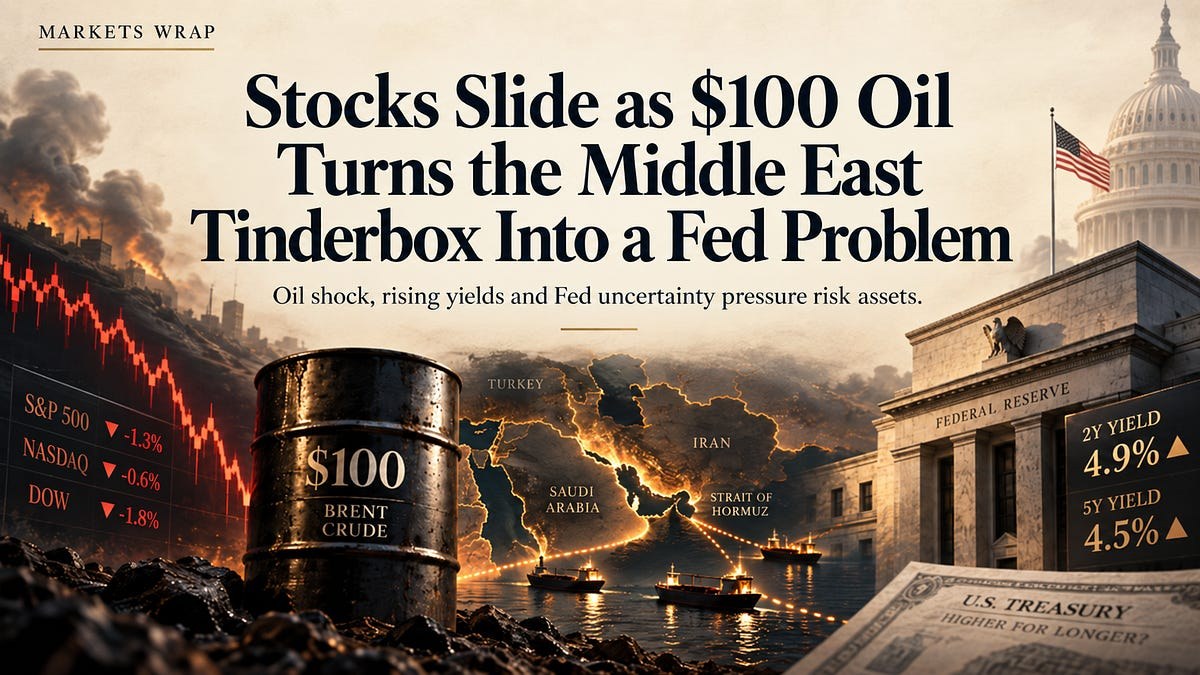
Stocks are no longer treating the Middle East as a contained geopolitical sideshow. Brent near $100/bbl is beginning to feed directly into yields, inflation expectations and the Fed debate.
-
The market had leaned heavily on the idea that higher gasoline prices would eventually force a diplomatic reflex. So far there has been no TACO, and that means traders have to price a longer oil shock.
-
The great unknown for equities is whether the Fed delivers a reversible insurance hike or whether that first move becomes the first domino in a short two- or three-hike tightening cycle.
Triple-Digit Oil Turns the Middle East Tinderbox Into a Fed Problem
Stocks came under pressure as the market returned from the long weekend to find that the Middle East was no longer content to sit quietly on the geopolitical side screen. The S&P 500 fell for a second session, and the Dow took the heavier hit, while Nasdaq managed to hold up better as the AI complex caught a fresh bid around Astra’s launch, helped along by a substantial short squeeze and a sharp reversal in momentum positioning.
That relative resilience mattered, but it should not be mistaken for an all clear. Beneath the AI enthusiasm, the broader cross-asset message was considerably less friendly as Brent pushed toward $100/bbl and front-end Treasury yields moved higher with it.
The more important signal was coming from rates. Crude was climbing toward triple digits and front-end Treasury yields were rising alongside it, the classic Middle East negative feedback loop returning to the scene of the action. The market is now beginning to factor in a more prolonged escalation, digesting a true oil shock that could linger long enough to harden the inflation outlook and drag the Fed deeper into the argument.
Fresh Houthi attacks on Saudi infrastructure, renewed US strikes around Kharg Island and Jask, threats toward Gulf shipping and continued disruption through Hormuz and the Red Sea have changed the texture of the move. Traders are no longer just asking how many barrels are temporarily stranded. They are starting to ask how long the disruption lasts.
That matters because an oil spike can be faded. An oil plateau is harder to ignore.
For much of the summer, the market had a familiar reflex. Crude would jump, gasoline would rise, political pressure would build, and diplomacy would eventually appear somewhere over the horizon. The approach of the US midterm elections only reinforced that assumption. Triple-digit oil and rising pump prices looked like the sort of combination that would eventually force Washington toward an exit ramp.
And if Washington is prepared to tolerate more pain at the pump in pursuit of broader geopolitical objectives, then the market has to stop assuming every oil spike carries its own diplomatic expiry date.
That is where the Middle East tinderbox starts becoming a genuine macro and Fed problem.
Brent in the $70s or low $80s is one thing. Brent leaning against $100/bbl while the labour market remains resilient is another. The latter feeds into inflation expectations, transport costs, household psychology, corporate margins and ultimately the policy debate.
For stocks, the great unknown is what the Fed does with it.
If policymakers deliver an insurance hike against an oil-driven inflation scare, markets can probably live with it. One hike can be reversed when and if the shock abates, crude retreats and the inflation impulse cools. Traders may not like it, but they understand the map and, more importantly, they can put a rough expiry date on the policy response.
The more difficult question is whether that insurance hike turns out to be the first of multiple hikes
Beyond the policy uncertainty already hanging over the Fed’s reaction function, that would be a very different proposition for equities. Even a short hiking cycle would force the market to rethink the rate path, the valuation backdrop and how much additional tightening the economy can absorb, all while heading deeper into what is already shaping up to be a contentious US midterm election.
The market can price one insurance hike. What becomes much harder is deciding whether that move is simply temporary cover against an oil shock or the first domino in a broader tightening cycle.
For now, the Nasdaq is getting some shelter from a very different weather system. Astra’s launch breathed fresh life into the AI complex at precisely the moment the broader market was wrestling with the oil shock, while a large short squeeze forced bearish positions back through the door and the momentum trade underwent one of those violent reversals that can make index-level resilience look healthier than the underlying market really is.
That combination matters because it explains why Nasdaq could outperform even as the macro backdrop deteriorated. This was not simply investors deciding that higher oil and higher yields no longer matter for growth stocks. Part of the move was thematic buying and part was positioning mechanics.
In other words, AI enthusiasm provided the tack into a macro squall, while short covering supplied the intermittent favourable gust.
That can carry the boat for a while, but if Brent stays near triple digits and yields keep grinding higher, the macro tide will eventually start pulling in the opposite direction.
This still looks more like a market recalibrating than capitulating, but the room for error is getting thinner.
FX told a similarly messy story. The yen strengthened to the low USD/JPY 153 area as stronger Japanese wage data reinforced the case for further BoJ tightening, while the broader dollar failed to produce the sort of clean upside one might normally expect from firmer US front-end yields.
That is another clue that this is not a simple broader FX correlation trade. The yen has its own monetary policy story, Europe remains highly sensitive to energy, and the dollar is sitting in the middle of a geopolitical shock whose inflation consequences are global rather than uniquely American.
As we have seen through numerous episodes this summer, gold can struggle when oil pushes sharply higher, with the inflation pass-through lifting yields and taking some of the lustre off the gold bars. Bitcoin, meanwhile, again behaved more like a high-beta liquidity asset than any sort of bunker against Middle East instability.
But it does suggest the summertime assumption playbook is becoming less reliable.
For most of the summer, traders could buy geopolitical dips because every escalation seemed to come with an assumed exit ramp. Somewhere between Hormuz, the Red Sea, Saudi infrastructure and Kharg Island, that trade has become considerably less comfortable.
Brent does not need to explode to $120/bbl tomorrow to upset the market.
It simply needs to stay high long enough.
The Middle East tinderbox has always had plenty of matches lying around. The problem now is that the fuse looks shorter, oil is sitting beside the Fed’s inflation gauge, and the market is discovering that the TACO reflex may not arrive simply because Brent has three digits in its sights.