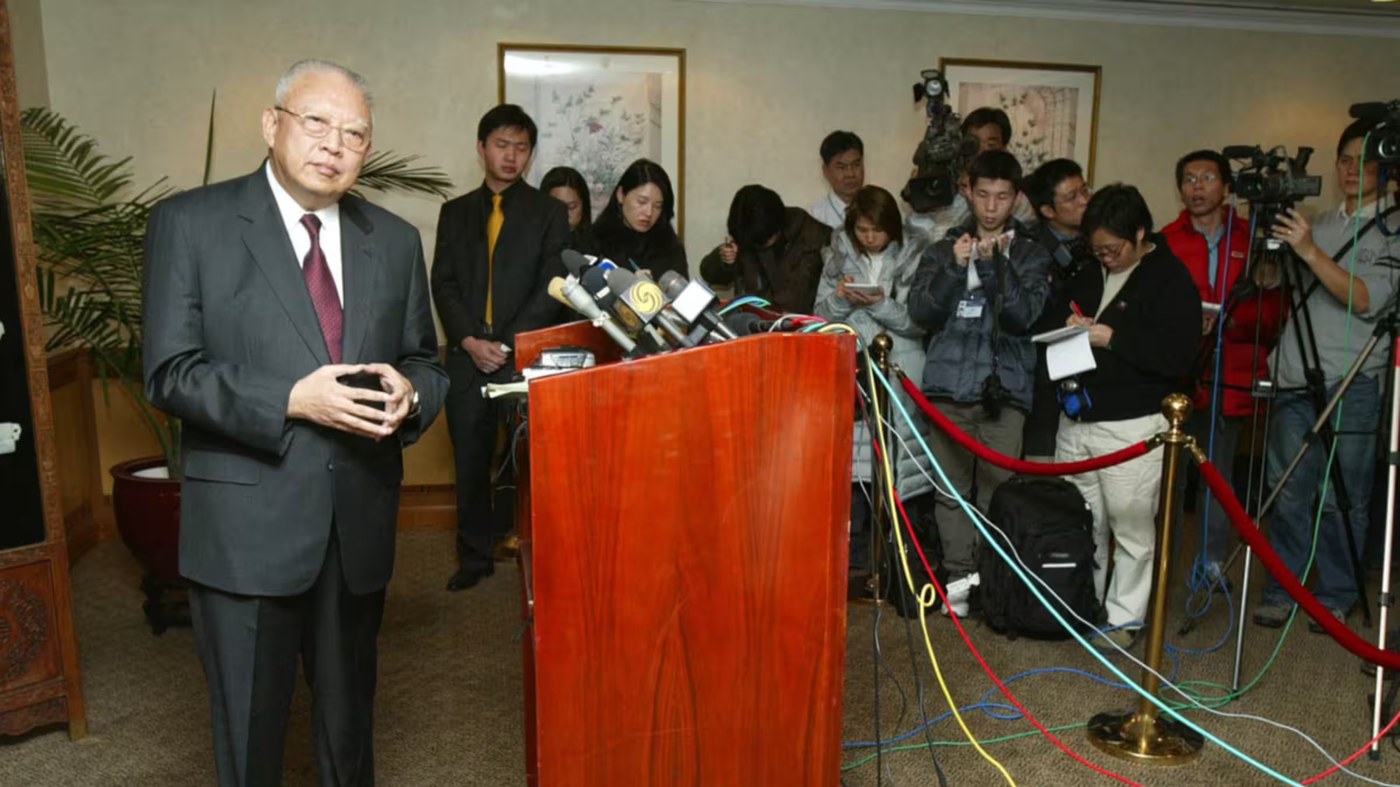
TOKYO -- Tung Chee-hwa, a businessman who emerged from the shipping industry to become the first chief executive of postcolonial Hong Kong, died on Tuesday, according to his office. He was 89.
Tung's office did not specify a cause of the death, but said he "passed away peacefully surrounded by his beloved family."
Tung, also known as C.H. Tung, became one of the city's most influential pro-Beijing political figures after the handover of sovereignty from the U.K. to China in 1997. His term, however, was marked by an ill-fated attempt to impose a national security law and by ensuing large public protests, a harbinger of the unrest and clampdown that would reshape the city years later.
In recent years, a reportedly ailing Tung stayed out of the public eye. He had left various positions, including chairman of the Our Hong Kong Foundation, a pro-Beijing think tank, and independent director of Alibaba Group Holding. He stepped down as vice chairman of China's top political advisory organization, the Chinese People's Political Consultative Conference (CPPCC), in March 2023.
China's state news agency Xinhua published an obituary on Wednesday that described Tung as a "prominent patriot" and an "intimate friend of the Chinese Communist Party." While the story was brief, it said he died on Tuesday at 9:57 p.m. local time, information that was not even provided by his own office.
Hong Kong's current Chief Executive John Lee issued his condolences, praising Tung's leadership of the city and in his later, largely symbolic position at the central government level. Lee said Tung "successfully steered Hong Kong through the turmoil of the Asian financial crisis" and other "challenges" but did not specifically mention the ill-fated security legislation and his unpopular real estate policy.
Tung's immediate successors Donald Tsang Yam-kuen and Leung Chunying, also known as CY Leung, also issued statements in Tung's honor.
The pro-Beijing heavyweight and his family were known for their ties to the Kuomintang, the Chinese Nationalist Party that long dominated Taiwanese politics, and to the West.
Tung was born in Shanghai on July 7, 1937, the day Japan began its full-fledged invasion of China. He was the eldest son of Tung Chao-yung, a shipping magnate better known as C.Y. Tung, who founded Orient Overseas, which would grow into one of the world's largest shipping conglomerates.
The family moved to Hong Kong in 1948 as the communists took over the mainland.
Their business maintained close ties with the Kuomintang regime, which fled the mainland to Taiwan after losing the civil war to the communist forces. The company's logo features a plum blossom, the flower of Taiwan.
Tung earned a bachelor's degree in marine engineering in 1960 from the University of Liverpool, where he became a lifelong fan of the city's soccer team. The university conferred on him an honorary doctorate in law in 1997.
Upon graduation, he moved to the U.S. and spent almost a decade there, including a stint working for General Electric. He returned to Hong Kong to join the family business and eventually took the reins in 1979, three years before his father died. For a long time, the younger Tung remained in his father's shadow, often referred to as "C.Y. Tung's son."
A major turning point came in the mid-1980s, when the company hit a serious financial snag. It was eventually rescued by a consortium led by major Japanese institutions but also including Bank of China, and by China Merchants Group, a Hong Kong-based state-owned conglomerate with shipping interests.
It is widely believed that this episode brought Tung closer to Beijing and opened his path to becoming Hong Kong's first chief executive in 1997, replacing Chris Patten, the last London-appointed governor. Even after he was virtually hand-picked by the end of 1995 to take the top post, Lu Ping, the head of the Hong Kong and Macao Affairs Office at the time, said the first chief executive would very likely be a low-profile "dark horse."
Tung's term is widely remembered for a failed attempt to implement a national security law based on Article 23 of the city's Basic Law, the local constitution. The proposed legislation sparked widespread opposition and an unprecedented mass movement, drawing half a million people to the streets on July 1, 2003, the sixth anniversary of the handover.
The legislation was abandoned, and Tung later stepped down during his second term in March 2005, citing a health issue. On the day of his resignation, he was appointed vice chairman of the CPPCC.
Beijing ultimately did impose a national security law on Hong Kong in June 2020, drastically reshuffling the city's political and social order and virtually eradicating any viable opposition from the legislature and civil society. The city's government under John Lee went on to implement its own security law based on Article 23 in March 2024, over two decades after Tung's setback.
Zipping through a Legislative Council filled with "patriots" screened by Beijing, the Safeguarding National Security Ordinance was passed unanimously. The streets remained quiet.
Tung served as an independent director of Alibaba Group Holding starting in September 2014, when the Chinese tech conglomerate went public in New York. When he stepped down, Alibaba's board commended Tung's contributions as exemplifying "the highest standards of care and committed service."
The family business was sold to China's COSCO Shipping Holdings in 2018. Tung and his younger brother, Tung Chee-chen, surrendered their entire 68.7% stake in a $6.3 billion deal that turned the Chinese state-owned shipping company into the world's third-largest player. At the time, Alan Tung Lieh-sing, Tung's son and an executive at the shipping company, explained that the deal was "solely a commercial decision."
Sporadic signs appeared that the former chief executive's health was deteriorating. Tung fell during the opening session of the National People's Congress in March 2021, and then missed the annual National Day celebration held in Hong Kong that October. It was later learned that he had undergone surgery for an undisclosed ailment a month earlier. He also skipped the official 25th handover anniversary ceremony attended by President Xi Jinping in July 2022.
One of Tung's last deals that caught attention surfaced in September 2022, when the city's land registry record revealed that he had purchased a Mid-Levels flat that he had been renting since becoming chief executive for 160 million Hong Kong dollars ($20.4 million). The purchase made him a first-time homebuyer at the age of 84.