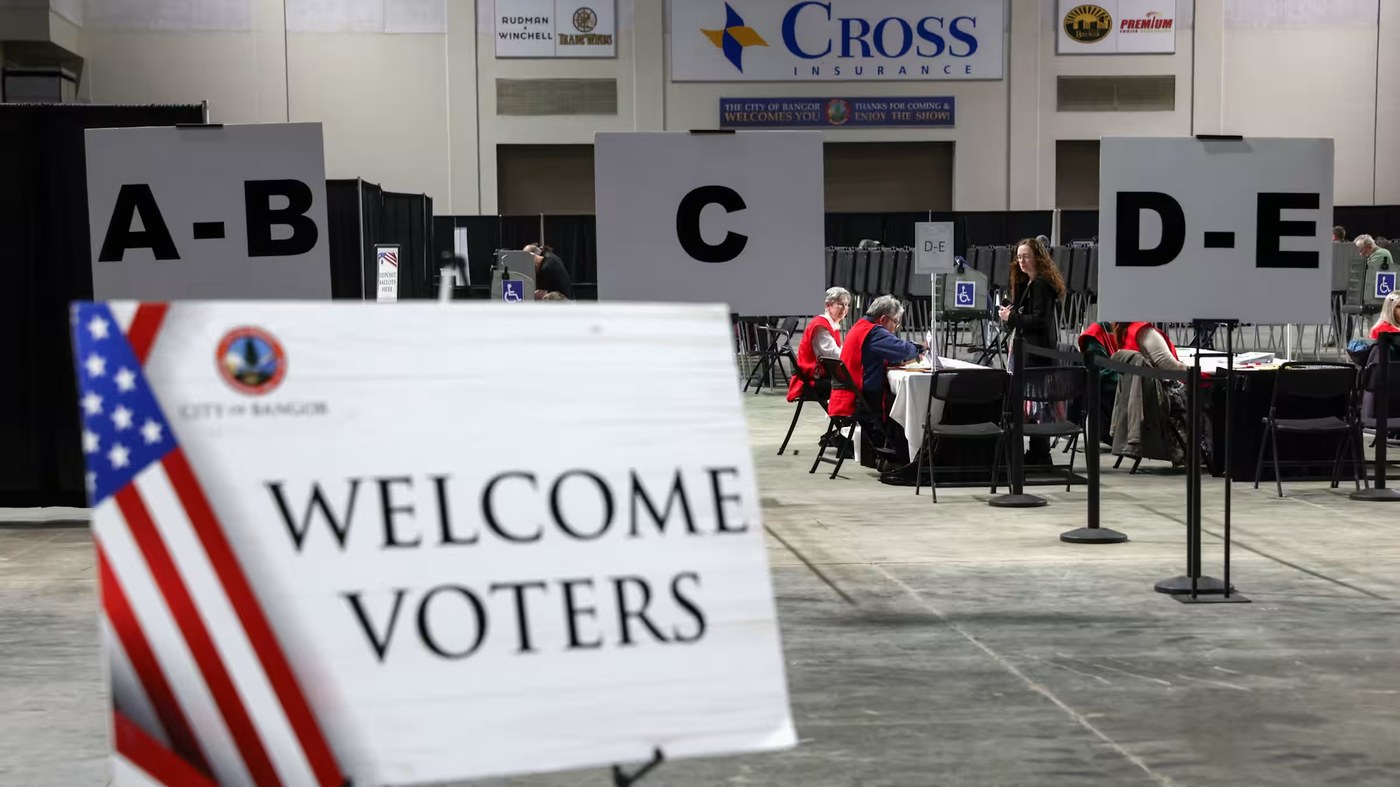
WASHINGTON/NEW YORK -- Polling has opened for the 2026 U.S. midterm elections, with control of both chambers of Congress in the balance.
In the weeks leading up to election day, projections have overwhelmingly favored the opposition Democratic Party to take control of the House of Representatives from President Donald Trump's Republican Party, while the battle for the Senate is expected to be much closer.
Results, particularly for the Senate, could hinge on a small number of close races, including in Alaska, where polls don't close until after midnight Eastern time. Recounts or litigation over contested results could drag the process out even longer.
Readers will be able to follow Nikkei Asia's live coverage and analysis of the midterm elections at asia.nikkei.com.
Follow the latest updates below: (Washington time)
11:55 a.m. Early voting surged ahead of election day, with 59.1 million in-person and mail-in ballots cast nationwide, the University of Florida's Election Lab reports. That is more than half the total ballots cast in the 2022 midterms.
The number of ballots cast via early voting in Colorado, Florida, Georgia, Montana, Nevada, North Carolina, Oregon and Tennessee was equivalent to more than 70% of each state's total 2022 turnout.
By party registration, Democrats accounted for 43% of early ballots and Republicans 31.4%, though registration does not indicate how voters cast their ballots.
The numbers may appear favorable to Democrats, but Republicans historically have been more likely to vote on election day and have less confidence than Democrats that mail-in ballots will be counted, Pew Research reports.
11 a.m. Heavy rain and flooding have forced some polling centers in Florida to relocate, with eight counties affected. Gov. Ron DeSantis issued an executive order on Monday to establish temporary voting centers "to ensure that residents in those areas in affected counties still have the ability to vote."
Flash flooding in the West also has affected Arizona, Utah and Colorado. Utah's lieutenant governor on Monday issued a "declaration of emergency election accommodation," allowing affected voters to request electronic ballots.
Rain and gusty conditions in parts of the Midwest and "strong to severe storms" in eastern Texas also were raising concerns about access to polling centers on Tuesday morning.
Historically, bad weather has suppressed voter turnout on election day.
10:45 a.m. Oil prices rebounded early Tuesday after reports of a fresh U.S. strike on Iran's Qeshm Island in the Strait of Hormuz renewed supply concerns on election day.
January Brent crude futures rose 1.8% to $106.63 a barrel, while U.S. West Texas Intermediate gained 2.4% to $97.08, reversing some of Monday's sharp losses. The strikes tempered hopes for a diplomatic breakthrough, though President Donald Trump said a peace agreement with Tehran "could still happen."
Higher energy costs are hitting Asian economies unevenly. China and India have been cushioned by domestic coal reserves, while Thailand, the Philippines and South Korea remain more exposed because of their reliance on energy imports, according to ING analysts.
Japan is expected to begin phasing out gasoline subsidies in December after reinstating them in the spring. The U.S. Energy Information Administration forecasts Brent will average $105 a barrel in the fourth quarter before falling to $84 in 2027 as regional logistics adjust.
10:05 a.m. Artificial intelligence has emerged as an unexpected flashpoint in the elections. Widespread local opposition to digital infrastructure is shaping campaigns in both the Democratic and Republican parties, even prompting allegations that China is fueling anti-data center sentiment.
Voters across the political spectrum are opposing data centers due to the heavy energy demands, fears of higher electricity rates and the way hyperscalers have pursued development. The issue has become prominent enough that moratoriums have made it onto ballots. One state to watch is Ohio, where data center development has accelerated and the world's largest AI data center is planned. Senate candidates from both parties are campaigning against the infrastructure or linking their opponents to its potential negative impacts.
Whatever the election outcome, growing resistance to data centers could have implications for suppliers, many of which are based in Asia.
9 a.m. Polls have opened for the 2026 midterm elections, widely seen as a referendum on President Donald Trump's agenda. Polling station hours vary by state and sometimes even within a state, so results will be reported this evening in staggered waves.
This election has prompted a surge in early voting, particularly in states with close Senate races. In South Carolina, early voting was up more than 80% from the previous midterms in 2022, The Associated Press reports, while the figure was 50% for Texas and 44% for Maine.
Top issues for voters include inflation and rising energy costs linked to the Iran war, trade tariffs and backlash against artificial intelligence data center projects.
Issues related to China, meanwhile, faded from campaign rhetoric.