WASHINGTON/NEW YORK/TOKYO -- Chinese President Xi Jinping and U.S. President Donald Trump have concluded their second formal summit of the year as amid continuing tensions over tariffs, rare-earth minerals, artificial intelligence and more.
Four months after Trump traveled to Beijing in May, the two presidents met this time in Washington. The White House welcomed the Chinese leader in elaborate fashion, including a state dinner. Soon after Xi arrived in the Washington, the U.S. said the two sides had agreed to extend their trade truce, which had been due to expire Nov. 10.
But expectations of broader breakthroughs were modest, and the immediate results did little to shift perceptions.
Xi urges limits on US-China rivalry, calls for human control of AI
Chinese CEOs travel to Washington despite summit invite uncertainty
US and China eye Trump-Xi talks on AI guardrails despite tech rift
China's hypercompetition goes global as Beijing frets over backlash
Tesla and the Musks 'Chinamaxx' as rumors swirl over EV maker's plans
Here are the latest developments (Washington time):
1:17 p.m. On his Truth Social platform, Trump bids farewell to Xi. "Much has been, and will be, accomplished," Trump writes. "I look forward to our next meeting!"
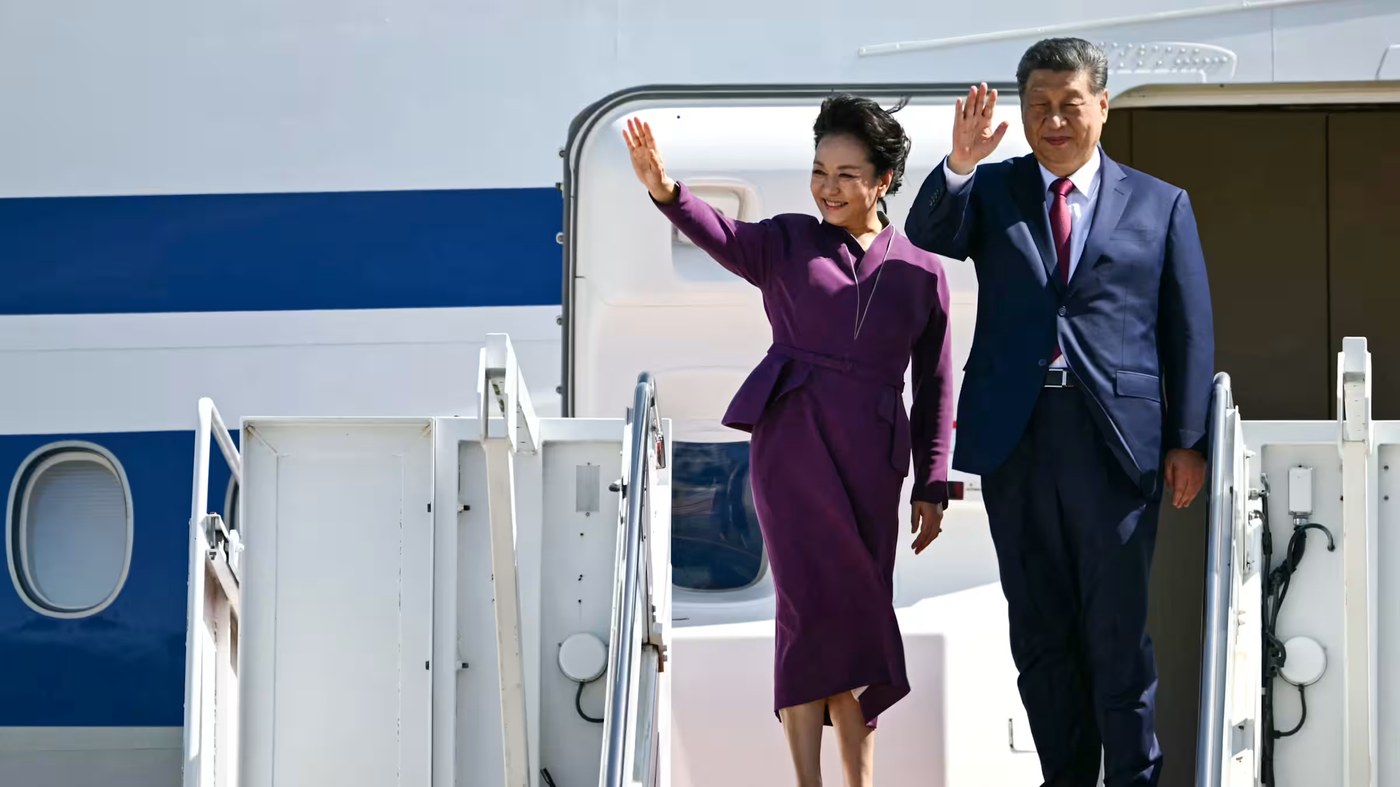
1:10 p.m. Xi and his wife, Peng Liyuan, board their plane at Joint Base Andrews, concluding their three-day visit to the United States.
12:15 p.m. Trump and Xi exchange a final handshake after a National Archives tour before Xi and his wife, Peng Liyuan, head to the airport.
11:20 a.m. Xi attends a tea ceremony with Trump. The Chinese leader says that he will welcome the U.S. president to come to China for the APEC Economic Leaders' Meeting in November and that he expects to meet with Trump again at the Group of 20 meeting in December. Trump says he will go to Shenzhen and that the two will "speak a lot." Xi says the prospects of relationships will get "brighter."
9:45 a.m. U.S. Trade Representative Jamieson Greer tells CNBC that details of the latest U.S.-China trade agreements will be released Monday.
Greer says Washington and Beijing reached deals covering a "subset" of non-sensitive goods that could receive more favorable trade terms, without specifying which products are covered or how tariffs might change.
8:50 a.m. Trump says on Truth Social that he had a "very productive meeting" with Xi and that "tremendous things will be happening." He does not provide further details.
7:20 a.m. The U.S. has yet to confirm details of yesterday's closed-door bilateral summit, but footage broadcast by Chinese state television shows that Vice President JD Vance was among the officials in the room. This marks the potential 2028 presidential candidate's first known encounter with the Chinese leadership since taking office.
6:30 a.m. The coast guard of the Philippines, a U.S. treaty ally, accused China on Friday of obstructing a resupply mission to its troops in the South China Sea, Reuters reports. A spokesperson said dangerous maneuvers by Chinese vessels "put Filipino personnel at risk" and prevented the mission from being completed, although there were no collisions or injuries. This is the latest of numerous confrontations between Chinese and Philippine forces in the disputed waters.
4:30 a.m. At the National Archives, the last scheduled stop of Xi's visit before his departure from Washington, the leaders will have a chance to view some of the most important documents in American history, including the Declaration of Independence and the Constitution. In addition, Trump has said they will see "artifacts testifying to the long and cherished relationship" between China and the U.S.
Analysts suggested to Reuters that Xi may want to see documents related to the U.S. decision to switch recognition to the People's Republic from Taiwan in 1979.
2:20 a.m. Taipei's Ministry of Foreign Affairs pushes back, after Xi told Trump that China wants the U.S. to uphold the "correct position" of opposing "Taiwan independence" and appeared to link the matter to overall relationship stability.
The Taiwanese ministry says Xi's comments are consistent with a pattern of "distorting facts" and stresses that the Chinese Communist Party "has no right to represent the Taiwanese people." It emphasizes democracy and insists Taiwan will continue to work with the U.S. and other partners to safeguard peace and stability in the Taiwan Strait.
2:00 a.m. As Xi's visit to Washington enters its final hours, economic pressures back home in China loom in the background. A recent high-profile tie-up deal between two major Chinese state-owned carmakers has raised the possibility of broader consolidation across the world's largest car market, analysts say, as Beijing's patience with chronic overcapacity in the industry wears thin.
11:30 p.m. Kolas Yotaka, a former spokesperson for Taiwan's presidential office, writes on X: "If 'one country, two systems' is the relationship China wants with Taiwan, then this new concept of "constructive strategic stability" is the relationship China wants with the U.S.," referring to the formulation for governing Hong Kong and Beijing's framing of its current ties with Washington. "Only difference? Taiwan doesn't accept China's terms. The U.S. just did. That's dangerous for Taiwan."
Yotaka, who is also an author, independent consultant and former legislator, suggests China is trying to box Trump in. It is "using this to demand the U.S. recognize its claim over Taiwan and delay arms sales -- or else it 'threatens' this new 'stability.' That would blow up the status quo."
9:50 p.m. According to the Trump administration, tomorrow's events will kick off when the presidents reconvene at the White House at 10:30 a.m. Trump and first lady Melania will have tea with Xi and his wife, Peng Liyuan. Later in the morning, they will pay a visit to the National Archives, concluding Xi's state visit.
9:45 p.m. Here's some footage from the summit so far.
8:30 p.m. While dinner is underway, Chinese supporters and anti-China protesters are stationed outside the White House, separated by a few blocks. Groups of Hong Kongers, Uyghurs, Tibetans and Chinese rights activists waving Tibetan flags chant "Free Hong Kong" and "Stop the Uyghur genocide," while supporters play the Chinese national anthem.
8:15 p.m. Xi begins his remarks by wishing everyone a happy mid-autumn festival, a Chinese occasion celebrating family traditions and reunions.
Wearing a Mao suit, Xi says he and Trump had "sincere, in-depth exchanges" earlier today and came to an understanding on many issues, which the Chinese leader describes as new substance for "the constructive strategic relationship." He sprinkles historical events into his remarks, including "ping pong diplomacy" in 1971 during Richard Nixon's presidency, when the U.S. and China rebuilt the bilateral relationship. He also mentions that George Washington had a large collection of Chinese porcelain.
Xi highlights historic trade ties and the partnership to defeat Japan in World War II, saying the Sino-U.S. "friendship forged in blood and fire will live on for generations."
Closing out his remarks, Xi acknowledges Trump's goal of "making America great again," but also notes China's commitment to achieving "national rejuvenation."
"These two goals are both ambitious and can surely be mutually reinforcing," he says.
8:00 p.m. Hosting a state dinner with Xi's delegation and business leaders, Trump praises the historic ties between the two countries. He goes off script to point out the construction of the new White House ballroom and invites Xi to have a look. "If we had it, we would have way more than 1,000 people."
Trump gifts Xi a statue of a bald eagle, a national symbol of U.S., which he says was designed by himself and first lady Melania.
At Trump's table are tech leaders Elon Musk of Tesla, Jensen Huang of Nvidia, Lisa Su of AMD and Tim Cook of Apple.
4:20 p.m. According to a readout of a White House meeting earlier in the day published by state-run Xinhua News Agency, Trump and Xi confirmed they will support each other in hosting the APEC Economic Leaders' meeting in Shenzhen and the G20 Summit in Miami this year.
Xi said the two countries have held new rounds of trade talks and reached a new arrangement, which is good news for the industries, people on both sides and the global economy.
On Taiwan, Xi said China hopes the U.S. will uphold the "correct position" of opposing Taiwan independence, handle the Taiwan question with prudence, and lay a solid foundation for China-U.S. strategic cooperation and the development of bilateral relations.
"The fact that the two heads of state have visited each other in less than six months is unprecedented in the history of China-U.S. relations," the readout quotes Xi as saying. "President Trump and I have maintained communication through various means, working together to steer the ship of China-U.S. relations."
4:11p.m. Xi called for U.S. and China to keep artificial intelligence under human control during a White House meeting earlier in the day, Chinese state-run Xinhua News Agency reports.
According to the readout published by Xinhua, Xi discussed issues including trade, artificial intelligence and Taiwan with Trump.
On AI, Xi said both China and the U.S. are major powers in artificial intelligence. While there is competition, there is also the potential for cooperation. Both sides should leverage their respective strengths rather than adopt a defensive stance.
Xi called for the two parties to continue their dialogue on AI, exchanging views on its risks and benefits, and work together to prevent its misuse.
"Humans must remain in control over AI technology, adhering to a human-centered and benevolent approach," Xi said.
The two leaders also discussed the Middle East, Ukraine, Korea Peninsula and other geopolitical issues.
3:30 p.m. History and high culture, along with local specialties, will be on the menu for tonight's state dinner.
A blanc de noir from Schramsberg, the same vineyard whose sparkling wine was served in Beijing at U.S. President Richard Nixon and Premier Zhou Enlai's "Toast to Peace" in 1972, will be poured.
The first lady's office describes the menu as "bringing the culinary traditions of both nations together." The meal will begin with yellow squash veloute with mushroom fricassee, followed by sesame-crusted sea bass with braised baby bok choy. For dessert, vanilla cremeux served with ice cream using honey from the White House beehive.
Attendees will be serenaded by opera singer Christopher Macchio, a sharp contrast to R&B music artist Ne-Yo, whose hit song "Because of You" delighted Xi's wife, Peng Liyuan, in 2015.
Trump expressed his frustration this week that his controversial ballroom was not complete in time for Xi's visit.
1:40 p.m. Xi leaves the White House after shaking hands with Trump and climbing into his limo. Xi is scheduled to return in the evening for the state dinner.
1:15 p.m. Trump says he and Xi had a "great meeting" as the two leaders head to the Marine One helicopter for a brief tour of the White House grounds, according to The Associated Press.
The presidents walk together to the helipad, where Trump points out the presidential seal and shows off nearby construction on a planned White House ballroom. The U.S. president has repeatedly highlighted efforts to complete the helicopter landing area in time for Xi's visit.
12:45 p.m. China supports a return to dialogue and negotiations on Iran and hopes all sides can reach a comprehensive agreement, including on the nuclear issue, Xi Jinping says in a bilateral meeting with Trump, according to state-owned Xinhua News Agency.
Xi says China has sought to help de-escalate tensions and believes the sovereignty and security of all nations should be respected.
12:30 p.m. Xi says China will send two giant pandas to Zoo Atlanta as a goodwill gesture, after Beijing recalled four pandas from the zoo in 2024 amid rising U.S.-China tensions.
China and Zoo Atlanta announced in April that male Ping Ping and female Fu Shuang would come to the U.S. under a panda conservation agreement. In the welcoming remarks, Xi says the pair will arrive at their new Atlanta home "in a few days" and calls panda exchanges an "envoy of friendship."
11:50 a.m. The summit schedule includes no joint news conference, and it remains unclear whether Trump and Xi will take questions from U.S. or Chinese reporters, according to the AP.
That marks a departure from Xi's 2015 White House visit, when he and President Barack Obama held a joint news conference in the Rose Garden. After opening remarks, each leader answered questions from both American and Chinese reporters.
10:45 a.m. In welcoming remarks delivered after the playing of the U.S. and Chinese national anthems, Trump says the two sides have made "tremendous strides" and will be discussing security, technology and "super intelligence," his term for AI. He adds that both countries are working to balance trade, including "new market access" for American farmers.
Invoking historic ties between China and the U.S., including their alliance during WWII, the U.S. president says they will focus on "common interests."
Xi, speaking at the White House for the first time since 2015, stresses the importance of partnership between the world's two largest economies, as well as the need for mutual respect and trust, while strengthening cooperation and communication.
"Without our cooperation between the U.S. and China, it'd be hard to solve many of the world's problems," he says.
10:30 a.m. Demonstrators are peacefully marching from the Chinese Embassy toward Capitol Hill in protest against Beijing's cultural repression in Tibet. In July, Tibetan activist Lobsang Palden self-immolated in front of the United Nations building and died from severe burns. The incident happened a week after an "ethnic unity" law came into effect in China. The legislation promotes integration across the country's 55 ethnic groups through various policies, but critics see it as an instrument to further repress minorities.
This week, a Tibet independence march was held in front of the U.N. headquarters in New York. Fifteen other Tibetan demonstrators have marched from New York through Philadelphia and toward Washington to honor Palden.
Chinese authorities have imposed policies of forced assimilation in Tibet, restricting the use of the Tibetan language and subjecting individuals to arbitrary detention. Rights activists say the Chinese Communist Party is systematically separating Tibetan children from their families to erase Tibetan identity, but the Chinese government has denied accusations of cultural repression.
10:15 a.m. The U.S. president and first lady welcome Xi and his wife to the White House.
9:12 a.m. World financial markets remained on edge on Thursday after concerns about the Iran war and inflation pain had triggered the sharpest sell-off in U.S. Treasurys and other benchmark government bonds since last year's "Liberation Day" turmoil, Reuters reported.
Bond yields were nudging higher again as U.S. trading began after oil prices had moved back above $105 a barrel and as traders waited on what could be a tense meeting between Trump and Xi in Washington later.
The 10-year U.S. Treasury yield -- the benchmark of the $29 trillion Treasury market that anchors pricing for virtually all financial assets globally --touched a new post-financial-crisis high of 5.12%, while the 30-year yield climbed to 5.44%, its highest since 2004.
8:00 a.m. Trump starts the day off with a Truth Social post, suggesting he will discuss AI with Xi.
"A big day with President Xi of China. Super Intelligence (SI) will be a big topic of discussion, but I want to leave it exactly where it is. That is China's position also," he writes.
"Our guardrail is the DOJ!" Trump adds, referring to the Department of Justice but not elaborating on what he means.
6:35 a.m. While the U.S. and Chinese leaders meet in Washington, trade tensions over what many consider China's industrial overcapacity are simmering elsewhere. The head of Germany's auto industry association, VDA, has explicitly endorsed new tariffs on China for the first time, Reuters reports, citing German media. Hildegard Mueller told newspaper Handelsblatt that trade countermeasures could be adopted when competition has been distorted beyond a certain extent, including cases of "proven unfair behavior."
While China's trade with the U.S. has declined, it has stepped up exports to Europe and Southeast Asia, and Germany's leaders have been raising alarm. Chancellor Friedrich Merz recently said China "deliberately" combines market forces with state subsidies, overcapacity, aggressive pricing and an undervalued currency.
European companies in China this week urged Beijing to address such concerns ahead of crucial talks with the bloc next month.
4:50 a.m. According to the schedule shared by the U.S., Trump will welcome Xi and his wife to the White House at 10 a.m. Shortly afterward, the leaders will observe an arrival ceremony, before delivering brief remarks, exchanging gifts and participating in military reviews.
At 11:30 a.m., with the pageantry out of the way, Trump and Xi will start a closed bilateral meeting in the Oval Office. Only half an hour is reserved for this, before they shift to an expanded meeting in the Cabinet Room at noon.
At 2 p.m., Trump is due to turn to his own briefings and meetings, until the leaders reconvene at 6:45 p.m. They are to deliver further remarks before tucking into a state dinner with business leaders.
3:45 a.m. China's Ministry of Defense calls for maintaining "stable and sound" relations with the U.S. military, while urging Washington to be "extremely cautious" about arms sales to Taiwan.
2:00 a.m. Major U.S. media outlets avoided broadcasting Trump's grand welcome for Xi, according to reports, as his administration feuds with the press. Trump recently sought to ban CNN, MS NOW and Politico from reporting from the White House, accusing them of reporting "lies." Fox News, which is generally friendly to Trump, also refrained from showing Wednesday's ceremony. A federal judge subsequently ordered Trump to restore White House access for journalists from the three affected outlets, saying the ban was likely unconstitutional, Reuters reported.
1:30 a.m. Taiwan's cabinet spokesperson, Michelle Lee, says Taipei expresses its "gratitude" for long-standing U.S. support.
"Regarding all efforts conducive to stabilizing the regional situation and managing the risks that authoritarian expansion might bring, we view them positively and continue to cooperate with the U.S. at various levels," she says, regarding the Trump-Xi meeting, according to Reuters.
"In fact, we continue to maintain close contact with the U.S. to stay informed of relevant developments."
12:35 a.m. Minoru Kihara, Japan's chief cabinet secretary and Prime Minister Sanae Takaichi's top aide, tells reporters in Tokyo that he will "continue to monitor the situation" at the Trump-Xi summit "closely with keen interest," amid Japan's own tensions with Beijing.
He stresses the significance of talks between Takaichi and Trump on the sidelines of the United Nations General Assembly earlier this week. "With the upcoming U.S.-China summit in mind, they exchanged views on various issues concerning China including economic security, and agreed to continue to closely cooperate," he said.
11:45 p.m. The European Chamber of Commerce in China applauds the extension of the trade truce between Washington and Beijing, saying that without it, "the implementation of the planned export controls on rare earths would have a crippling impact on industry."
However, it raises several concerns, including uncertainty over what will happen after the new expiry date of Jan. 10.
"The extension does not address underlying challenges companies experience when it comes to applying for both single and general export licenses" for rare earths, it adds. The chamber flags "a lack of coordination" between Chinese commerce and customs authorities, inconsistent disclosure requirements and "a lack of clarity as to why some applications are unsuccessful."
11:00 p.m. As the U.S. was preparing to welcome Xi, Chinese human rights activist Shi Tingfu died in prison in the country's northwestern region of Xinjiang on Tuesday, according to the Chinese-language website Rights Defense Network (RDN).
Shi, an outspoken advocate of freedom and democracy from Nanjing who supported the 1989 Tiananmen protests, was detained by Xinjiang police in January 2024 and later sentenced to three years in jail for "picking quarrels and provoking trouble." He was expected to be released in about four months.
The death of the 67-year-old activist underscores questions over whether Trump will press Xi on human rights issues in their meeting on Thursday, beyond raising the cases of two Americans held by Beijing.
Shi's conviction was due to passing information to overseas media about fruit farmers in the western Xinjiang city of Aral, or Alar, lodging grievances against Xinjiang Production and Construction Corps, a state-run paramilitary organization and corporate conglomerate.
The Network of Chinese Human Rights Defenders said it could not definitively confirm that his death resulted from inadequate medical care. He suffered from multiple health conditions, including high blood pressure, pneumonia and asthma.
But according to RDN, his family said he had appeared to be in good condition and did not mention feeling unwell during a visit not long ago, "raising concerns about the circumstances of his sudden death."
On another front, the Tibet Action Institute reports that China has been enforcing a "complete information blackout across Tibet" following catastrophic landslides and floods at the border with Nepal last month.
"Xi Jinping's regime tried to make Tibet invisible after the devastating border floods," said Tenzin Dorjee, the institute's research and advocacy director, by "blocking journalists, silencing victims, and censoring the internet -- all to mask the truth of its occupation and colonization of Tibet." She called on Trump to press Xi to allow access and end the "relentless repression" of Tibetans.
10:30 p.m. The White House has posted a short video clip of Trump's welcome for Xi.
10:00 p.m. Days ahead of his U.S. visit, Xi wrote back to nearly 100 students from 10 U.S. universities who had been in China for an exchange program, according to the state-owned Xinhua News Agency. He urged them to foster bilateral ties.
Yet, even as leaders trade diplomatic overtures, academic and people-to-people exchanges between the two superpowers remain severely chilled after years of deepening political mistrust. The pipeline for American scholars going to China has nearly dried up. And the number of U.S. students studying in China has dropped sharply from roughly 11,000 in 2019 to fewer than 2,000, with most concentrated in short-term undergraduate programs, according to the U.S.-China Education Trust.
At the same time, Chinese students are increasingly shunning American universities amid tighter visa restrictions and heightened immigration scrutiny. The number of Chinese students on American campuses fell from a peak of more than 370,000 in the 2019-2020 academic year to nearly 266,000 by 2024-2025.
8:30 p.m. According to a list shared with media, the welcome ceremony for Xi featured: a 100-foot red carpet; a salute battery; a 21-person honor cordon; a pair of three-person color teams with the U.S. and Chinese flags; a U.S. Air Force band playing fanfare and the countries' national anthems; 3x5 platoons from each service; two B1 flyovers; and flower presenters.
6:20 p.m. Treasury Secretary Scott Bessent told Fox News that he and Chinese Vice Premier He Lifeng agreed to extend a trade truce through Jan. 10, two months beyond its Nov. 10 expiration date.
5:41 p.m. Chinese President Xi Jinping arrives in Washington to a rare tarmac welcome from President Donald Trump, who breaks with convention by greeting his counterpart planeside.
Trump and first lady Melania Trump are to take part in an arrival ceremony for Xi and his wife, Peng Liyuan, kicking off a three-day state visit.
4:30 p.m. Before President Donald Trump's tariffs, China bought about half of U.S. soybean exports. Since then, shipments have fallen sharply, from nearly $18 billion in 2022 to $3 billion in 2025, according to U.S. Department of Agriculture data.
The decline has helped Brazil and Argentina gain market share. Brazil exported a record 108.7 million metric tons of soybeans in 2025, up 11.7% from a year earlier, with about 80% headed to China, according to the National Association of Cereal Exporters.
"No one can replace the Chinese market," Dave Walton, vice president of the American Soybean Association and an Iowa farmer, tells the Associated Press. Walton says he hopes U.S. tariffs are removed, adding: "We think of Xi as a friend to American agriculture."
3:30 p.m. Secretary of State Marco Rubio says the U.S. and China have a responsibility to engage at the highest levels, calling regular contact between the world's two largest economies "responsible statecraft."
"The idea that we would not interact with them at the highest levels is irresponsible. It's outrageous. We have to," Rubio tells reporters on the sidelines of the U.N. General Assembly, according to the Associated Press.
His comments come hours before President Donald Trump is set to welcome Chinese President Xi Jinping at Joint Base Andrews in a rare tarmac ceremony.
2:00 p.m. Security in Washington is being beefed up as Chinese diaspora groups plan welcome events and activist groups prepare demonstrations in conjunction with tomorrow's summit.
Road closures around the White House are already in place. The U.S. Secret Service, which is leading security for Xi's visit, says it is committed to ensuring the safety of foreign heads of state who are in the U.S.
Chinese, Hong Kong, Tibetan and Uyghur activists say they expect several thousand people to protest on Thursday.
"We're all protesting for a simple reason ... because our people who used to say these things, who used to organize these demonstrations back at home, are now locked up behind bars in prisons, in concentration camps and are stripped away from their political freedom and rights," says Joey Siu, a Hong Kong human rights activist.
Activist groups clashed with Chinese government supporters when Xi visited San Francisco for the Asia-Pacific Economic Cooperation summit in 2023.
The Secret Service says it is prepared to manage any demonstrations to ensure that freedom of assembly and speech are expressed "safely."
"If individuals or groups decide to act unlawfully, plans have been put in place to address them efficiently and safely," the Secret Service says in a statement.
1:05 p.m. U.S. Treasury Secretary Scott Bessent says he has held "substantive discussions" with China's He Lifeng on the bilateral economic relationship ahead of Trump's summit with Xi.
11:30 a.m. U.S. Treasury Secretary Scott Bessent is meeting with Chinese Vice Premier He Lifeng again hours before Xi is set to arrive in Washington.
"We have some unfinished business from Sunday," Bessent tells reporters here when asked what prompted this meeting, his second talk with He this week.
"We want strategic stability, but it has to be based in reciprocity and fairness," Bessent also says.
During closed-door negotiations Sunday at JPMorgan headquarters in Manhattan, the two sides agreed to carve out "nonsensitive" goods from future tariff actions.
7:40 a.m. There are signs of a generational shift among Americans in how they look at their country's biggest competitor. Younger and Democratic-leaning Americans, in particular, are warming up to the idea of building closer ties with China rather than decoupling, studies show.
A survey by the Chicago Council on Global Affairs released this week found 57% of American respondents favored engaging with China, the highest level since 2020 during the COVID-19 pandemic. The same poll found that Americans themselves perceive global respect for the U.S. to have declined over the last 10 years, while most respondents said respect for China was either about the same or had increased.
According to the Ronald Reagan Institute Summer Survey, 93% of Americans aged 65 and above expressed concern about Chinese espionage, compared with just 62% of those aged 18 to 29. The younger set was also less likely to worry about a potential military conflict over Taiwan, Chinese purchases of U.S. land and China's role in fentanyl flows.
Data on how Chinese citizens view America is far less accessible, though recent downtrends in Chinese visiting and studying in the U.S. indicate caution along with the effects of rising visa restrictions and tighter immigration rules.
7:00 a.m. Xi is heading stateside at a time when China's global image has improved, at least in relation to the U.S.
A report by Gallup published in April shows that China surpassed the U.S. in global approval ratings in 2025. A median 36% approved of Chinese leadership versus 31% for the U.S. -- the widest gap in China's favor in nearly 20 years.
This appears to reflect not only Xi's efforts to portray Beijing as a responsible power but also deteriorating views of America in Trump's second term. "Overall, China's move ahead of the U.S. more broadly reflects a decline in U.S. ratings rather than an increase in China's ratings," the report says.
A more recent survey by the Pew Research Center, conducted across 37 economies, found that a median of 51% of respondents had a favorable view of China. Feelings toward the country were warmest in Southeast Asia, Africa and Latin America, where China has deepened its trade ties in recent years.
Confidence in both Trump and Xi was generally low, according to Pew, though people from 22 countries viewed Xi more favorably of the two. Respondents in only eight countries, including Japan and Israel, expressed significantly greater confidence in Trump than Xi.
Still, the Pew survey found the U.S. government ranks higher than Beijing in terms of respect for personal freedom.
6:30 a.m. This will be Xi's first official state visit to the U.S. since 2015, and his first time setting foot on American soil since the APEC forum in 2023. Much has changed for both countries over the past decade -- key context for how the two administrations may approach relations.
In the U.S., a booming stock market fueled by artificial intelligence-related investments has supercharged wealth among high-income households. But middle- to low-income families face higher costs of living, exacerbated by elevated energy bills due to Trump's war against Iran.
The 20% richest Americans now account for 60% of personal spending, according to Mark Zandi, chief economist at Moody's Analytics.
Polls suggest that the affordability problem has eroded Trump's popularity. One released this week by Reuters/Ipsos found that only 32% of Americans approved of the president's job performance, the lowest of his career, while just 17% approved of his handling of living costs.
There is no publicly available polling on Xi's performance atop China's Communist Party state. Still, there are signs of brewing discontent due to labor market pains. Youth unemployment hit a record of 18.9% in August, amid widespread adoption of AI.
China has cemented its grip on global manufacturing with a record trade surplus of over $1 trillion, despite Trump's repeated attempts to loosen that hold with tariffs since his first term in 2018. And Chinese companies are making rapid technological advances. Yet the country also faces a two-speed economy: a yearslong property slump has dented family wealth and suppressed retail spending, while overall official growth rates continue to trend downward.
6:10 a.m. Here's the scene at Joint Base Andrews in the wee hours of Wednesday, ahead of Trump's welcome for Xi.
6:00 a.m. At a forum in Sydney earlier, experts in Asian and military affairs offered cautionary assessments.
John Aquilino, a retired commander of the U.S. Indo-Pacific Command, said China is conducting the largest military buildup since World War II. "Their industrial base is in a wartime footing. They are cranking out ships, submarines and airplanes like it's their day job. That is for only one reason, and that is for the PRC to change the current world order in ways that benefit China at the expense of all of us," he said.
Aquilino emphasized a need for the U.S. to work with allies on economic alternatives and deterrence. On the upcoming summit, he said the direction of conversations about Taiwan "absolutely concerns me." Reuters reported this week that Xi is likely to push Trump to halt new arms sales to Taipei.
Kurt Campbell, a former U.S. deputy secretary of state and co-founder of The Asia Group, said at the same event that Xi is trying to "reduce the confidence in Taiwan in the United States" by framing "how to think about Taiwan and resisting arms sales."
Lai I-Chung, president of the Prospect Foundation think tank, said Taiwan will be watching the summit "very closely" but stressed that the island democracy's fate will "not be determined by the negotiation between those two powers."
5:45 a.m. Tesla CEO Elon Musk says Xi is a "great leader" in an interview aired by Chinese state broadcaster CCTV. The billionaire, who is reportedly due to join Thursday's state dinner with the two presidents in Washington, says China has "prospered immensely" during Xi's time in power.
Musk has repeatedly praised China in recent weeks, while denying rumors that he is looking to break off Tesla's operations there.
5:15 a.m. A commentary in the Communist Party's People's Daily presents a broadly upbeat view of the summit. "The China-U.S. relationship is the most important and complex bilateral relationship in the world, and head-of-state diplomacy serves as the 'guiding star' of this relationship," it reads. It repeatedly emphasizes "constructive strategic stability," a framing of the superpower relationship that emerged at the May summit.
In a separate piece in the People's Daily, China's ambassador to the U.S., Xie Feng, lays out boundaries. "China's sovereignty, security, and development interests cannot be violated, and four red lines -- the Taiwan question, democracy and human rights, development paths and systems, and development rights -- cannot be challenged."
5:05 a.m. Xi is en route for Washington, Chinese state news agency Xinhua reports. The announcement says he is accompanied by his wife, Peng Liyuan, along with top aide Cai Qi and Foreign Minister Wang Yi, "among others."
He is scheduled to land in the early evening at Joint Base Andrews, where he is due to be greeted by Trump himself -- a rare diplomatic courtesy.
In a note, Oxford Economics says that the trip is "a sign the U.S.-China relationship is becoming more predictable." Yet, the advisory firm says both sides are "buying time."
"China wants to preserve export access while reducing external technology dependence. The U.S. wants to limit near-term supply-chain disruption and build manufacturing capacity at home. Economic interdependence is difficult to unwind, and both sides need time to build credible substitutes."
The analysts predict "narrow" and "reversible" outcomes, including limited tariff relief, a potential expansion of commitments to purchase farm goods and aircraft, and pledges to cooperate on issues like AI safety and Iran. "That would leave the thornier issues around tech rivalry, transshipments and Taiwan unresolved."